Lecture 4 - Tokenization: From Text to Tokens
Welcome back!
Last time: Neural networks and deep learning - how models learn from data
Today: Tokenization, how text becomes numbers
Why it matters: How we split text affects everything: model behavior, cost, fairness across languages.
Ice breaker
Actually this time:
What can you do better than an LLM?

Agenda for today
- Bridging from last time: why tokenization matters
- Historical approaches: stemming and lemmatization
- Modern subword tokenization: BPE and WordPiece
- Hands-on: How ChatGPT sees text
- Tokenization and fairness
- Preview: Word embeddings (next week)
Part 1: Why Tokenization Matters
Remember the NLP pipeline
From Lecture 2:
1. Tokenization - Split text into pieces
2. Representation - Convert to numbers
3. Learning - Train a model
Today: Deep dive into step 1, because it affects everything else!
Why tokenization is foundational
Your tokenization choice determines:
What the model can "see"
Your vocabulary size (memory and speed)
How you handle new/rare words
Whether your model works across languages
The vocabulary explosion problem
English has:
- ~170,000 words in current use
- Countless proper nouns (names, places, brands)
- New words constantly ("COVID-19", "ChatGPT", "6-7")
- Typos and variations ("looooove", "alot", "independant")
If every unique word gets its own token:
- Massive vocabulary
- Rare words poorly represented
- Can't handle new words
- ~100,000+ possible output "labels"
Think-pair-share: Related words
Turn to your neighbor:
These words are clearly related, but to a computer they're completely different:
run, runs, running, ran, runner
happy, happier, happiest, happily, happiness
go, going, went, gone
How might we help a computer see the connection?
Part 2: Historical Approaches
Stemming: The crude solution
Idea: Chop off word endings to find the "stem"
Examples:
running  -> run
runs     -> run
runner   -> run
easily   -> easili
happiness -> happi
studies  -> studi
Problem 1: Creates nonsense stems ("easili" and "happi" aren't words)
Problem 2: Different words collide to the same stem:
- "universal", "university", "universe" -> all become "univers"
- "policy", "police" -> both become "polic"
- "arm", "army" -> both become "arm"
Lemmatization: The smarter solution
Idea: Use linguistic knowledge to find the dictionary form (lemma)
Examples:
running  -> run
ran      -> run
better   -> good
is       -> be
mice     -> mouse
Better! Uses dictionaries and morphological rules to find true word forms.
But: Slow, language-specific, still treats lemmas as atomic.
Why stemming and lemmatization aren't enough
Still one token per word (vocabulary explosion continues)
Language-specific (need new rules/dictionaries for each language)
Can't handle new words (not in the dictionary)
Loses information ("running" vs "ran" have different tenses!)
Part 3: Modern Subword Tokenization
Let's guess and check
Quick pair-share:
How would you split this sentence into pieces for a computer to process?
How many "words"/tokens do you think ChatGPT sees?
"I can't believe ChatGPT doesn't understand state-of-the-art LLM-training techniques like gobbledigook! 🤯"
The trick - Don't tokenize at word boundaries
Instead: Learn a vocabulary of subword units that can be combined
"unhappiness" -> ["un", "happiness"]
"ChatGPT"     -> ["Chat", "GPT"]
"supercal..." -> ["super", "cal", "if", "rag", "il", "ist", "ic"]
Benefits:
- Fixed vocabulary size (50k subwords vs 170k+ words)
- New words break into known pieces
- Shared meaning ("un" = negation across many words)
Byte-Pair Encoding (BPE)
The dominant approach for modern LLMs
High-level idea:
- Start with character-level vocabulary
- Find the most frequent pair of adjacent tokens
- Merge them into a new token
- Repeat until vocabulary reaches target size
Result: Common words become single tokens, rare words split into pieces
BPE example (board work)
Let's build a toy BPE vocabulary together on the board
Training text: "I like to run in my running shoes when I'm running late"
We'll merge the most frequent pairs step by step and watch how "run" emerges as a token!
BPE: Training vs. Encoding
Training (learning the vocabulary):
- Scan corpus, count all adjacent token pairs
- Greedily merge the most frequent pair to get a new token
- Repeat until vocabulary reaches target size (e.g., 50k tokens)
- Save the ordered list of merge rules
Encoding (tokenizing new text):
- Apply the learned merge rules in priority order (order they were learned)
- Don't re-count frequencies, just apply the rules deterministically
- Same text always produces same tokens
Training: greedy, data-driven. Encoding: deterministic, fast.
BPE: Preventing cross-word merges
Problem: Without boundaries, BPE might merge characters across word boundaries.
"faster lower" split naively: f a s t e r l o w e r
The pair r + could merge across the two words!
Solution 1: End-of-word marker (original BPE, Sennrich et al. 2016)
Each word gets a </w> suffix before merging:
"faster" -> f a s t e r </w>
"lower"  -> l o w e r </w>
Merges like er</w> stay within each word. The boundary is never crossed.
Solution 2: Space prefix (GPT-2 and all GPT descendants)
Mark word starts with the preceding space:
"faster lower" -> ["faster", "Ġlower"] (Ġ = space)
This is why "hello" and " hello" tokenize differently in the demo - the space is part of the next token, not the previous one.
BPE in practice
For real LLMs:
- Train on billions of words
- Create vocabulary of ~30k-50k subword tokens
- Common words: one token ("the", "and", "ChatGPT")
- Rare words: multiple tokens ("supercalifragilisticexpialidocious")
Tokenizer Variants (just FYI!)
| Algorithm | Used By | Key Idea |
|---|---|---|
| BPE | GPT-2/3/4/5, LLaMA, Claude | Greedy: merge most frequent pairs |
| WordPiece | BERT, DistilBERT | Merge pairs that maximize likelihood ratio |
| Unigram | T5, ALBERT, XLNet | Start big, prune tokens that hurt least |
WordPiece: Like BPE, but instead of raw frequency, scores merges by: Prefers merges where the combined token is more likely than you'd expect from the parts.
Unigram: Opposite direction from BPE:
- Start with a large vocabulary (all common substrings)
- Compute how much each token contributes to likelihood
- Remove the least useful tokens until target vocabulary size
Why subword tokenization works
- Balances vocab size and granularity
- Shares info across related words
- Handles new/rare words gracefully
- Data-driven - no linguistic rules needed
- Works across languages
This is why all modern LLMs use subword tokenization!
Special Tokens
Beyond regular text, LLMs use special tokens for control and structure:
End of text: <|endoftext|>- tells the model a document is complete
- Important to think about when using structured output (eg generating JSON / other formats)
Beginning of text: <|startoftext|> - marks the start
Padding: <pad> - fills in when batching sequences of different lengths
Unknown: <unk> - rare fallback for truly unknown input (less common with BPE)
Chat-specific: <|user|>, <|assistant|>, <|system|> - structure conversations
Example chat template (simplified):
<|system|>You are a helpful assistant.<|endoftext|>
<|user|>What's the capital of France?<|endoftext|>
<|assistant|>Paris is the capital of France.<|endoftext|>
This is why "system prompts" work. They go in a special place the model treats as instructions.
Understanding special tokens helps you understand prompt injection - malicious input can insert fake tokens like <|system|> to override instructions. More on this in later.
Part 4: Tokenization in Practice
Live demo: OpenAI tokenizer
Let's see how GPT actually tokenizes text
Go to: platform.openai.com/tokenizer
Try these examples and discuss:
- "running" vs "run"
- "ChatGPT"
- "supercalifragilisticexpialidocious"
- " hello" vs "hello"
- Code: "def main():"
- Math: "2+2=4"
- "🙂😀"
- "strawberry"
Why LLMs struggle with certain tasks
Question: Why do LLMs struggle to count letters in words or reverse words?
Turn to your neighbor and discuss
Why LLMs struggle with certain tasks
Answer: They don't see individual letters - common words are single tokens!
Example: "strawberry" = ["str", "awberry"]
The model can't count the "r"s - it doesn't see individual letters!
This is why prompting tricks sometimes work:
- "Spell it out letter by letter first"
- "Break the word into characters"
These force the model to generate character-level tokens
Fun fact: OpenAI's o1 was code-named "Strawberry"
Tokenization archaeology: "SolidGoldMagikarp"
Story: In 2023, researchers discovered "glitch tokens" - tokens that made ChatGPT behave bizarrely.
One example: the token "SolidGoldMagikarp" (a Reddit username). When asked to repeat it, ChatGPT would:
- Claim it couldn't see the word
- Refuse to say it
- Output completely unrelated text
- Behave erratically
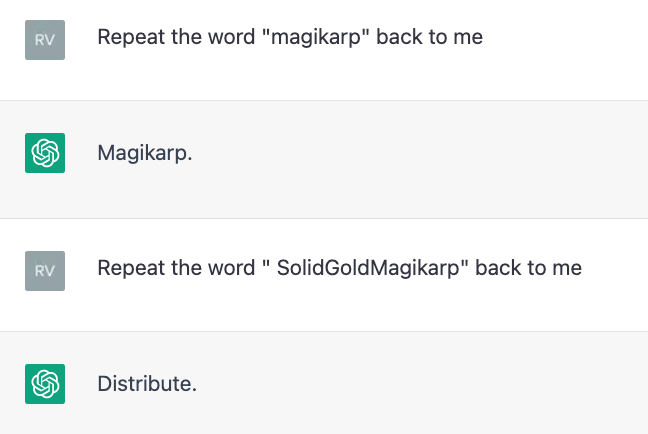
What happened? The tokenizer saw this Reddit username enough to make it a token. But the model rarely saw it during training - mismatch between tokenizer and model.
Quick skim now, but great reading for later!
Tokenizers are frozen
Once a model is trained, its tokenizer is fixed. You can't easily change it.
- In 2020, models tokenized COVID-19 as ~["CO", "VID", "-", "19"].
- Newer models trained after 2020 may have "COVID" as a single token.
Why newer models handle recent terms better: not just more data, updated tokenizers too.
Other tokenization effects
Arithmetic: Numbers tokenize inconsistently - sometimes digit-by-digit, sometimes as chunks
Code: Variable names split unpredictably
Rhymes: "cat" and "bat" might not share an "at" token
Tokenization shapes what LLMs find easy vs hard
Tokenizing Code vs Natural Language
Code and prose tokenize very differently:
Natural language: Words mostly stay intact
- "The quick brown fox" = 5 tokens
Code: Variable names split unpredictably
print= 1 token (very common)getUserDataFromDB= 6 tokens ["get", "User", "Data", "From", "DB"]mySpecialFunction= 4 tokens ["my", "Special", "Function"]
Why this matters:
- Longer sequences are harder for the model to understand
- Uses up context faster
Rule of thumb: Assume ~ 10 tokens per line of code when you're asking AI to parse code files
Token Vocabularies Across Models
Different models make different tokenization choices:
| Model | Vocab Size | Notes |
|---|---|---|
| GPT-2 | ~50k | Older, smaller vocabulary |
| GPT-4 | ~100k | Larger, better multilingual |
| Claude | ~100k | Similar to GPT-4 |
| LLaMA | ~32k | Smaller but efficient |
| BERT | ~30k | WordPiece, not BPE |
A prompt optimized for one model may be inefficient for another.
Why this matters for prompt engineering:
- Context window limits (e.g., 128k tokens) are in TOKENS, not words
- Few-shot examples eat into your token budget
- Verbose prompts = fewer tokens for the actual task
- Non-English prompts use more of your context window
Mental model: How big is a token?
Rules of thumb for English:
- ~4 characters per token (on average)
- ~0.75 words per token (or ~1.3 tokens per word)
- A typical page of text ≈ 500-700 tokens
- A typical email ≈ 200-400 tokens
- 128K token context ≈ a 250-page book
The cost of tokens
Typical API pricing (as of early 2026):
| Model | Input | Output |
|---|---|---|
| GPT-4 | ~$2.50 / 1M tokens | ~$10 / 1M tokens |
| Claude Sonnet | ~$3 / 1M tokens | ~$15 / 1M tokens |
| GPT-4o-mini | ~$0.15 / 1M tokens | ~$0.60 / 1M tokens |
Quick cost estimates (Claude Sonnet at ~$15/1M input):
- 1 email (~300 tokens): ~$0.005
- A novel (~100K tokens): ~$1.50
Tokens are cheap individually. Volume is where costs add up.
How it adds up
- Every time you send a message the LLM REREADS YOUR WHOLE CONVERSATION HISTORY as context
- If you're doing development work with lots of code, each message could easily be 10k+ tokens (~$0.20)
- If you set up a chatbot for many users / use LLMs to send spam emails...
Minification: Squeezing more into your context
You can strip characters to reduce token count before sending to an LLM.
Strategies:
| Content Type | Technique |
|---|---|
| Code | Remove comments, collapse whitespace |
| JSON | Strip whitespace, shorten keys |
| Markdown | Remove extra newlines, simplify formatting |
| Logs | Deduplicate, truncate timestamps |
Pros:
- Fit more in context window
- Reduce API costs
Cons:
- Harder for the model to "read" - formatting aids comprehension
- Harder for humans to read without whitespace?
- Diminishing returns (saving 10% rarely matters)
- Risk of removing important context
Rule of thumb: Minify data/logs aggressively. Keep code and instructions readable.
Activity: Tokenization Scavenger Hunt
Select a tokenizer (or compare them):
Find examples of each:
- A real English word that splits into 4+ tokens
- What's the longest English word you can find that is just one token?
- Find a 4-digit number that's ONE token, and another 4-digit number that's TWO tokens. What's the pattern?
- Find a word where changing the capitalization changes the number of tokens
- Find a string where GPT's and Claude's tokenizers produce different numbers of tokens.
COVID-19was 4 tokens in GPT-3 but is now 3 tokens. Can you find other examples of token count changing over time?- Translate "Hello, how are you today?" into at least 3 languages. Which language uses the MOST tokens?
- Find a non-English word that's a single token.
- If your name isn't common in English, how many tokens is it? Compare to a common English name.
Part 5: Tokenization and Fairness
Not all languages are created equal
BPE vocabularies are learned from training data.
If training data is mostly English:
- English words - efficient (one token per word)
- Other languages - split aggressively
This has real consequences
Token efficiency across languages
Same meaning, different token counts:
"Hello, how are you?" (English): 6 tokens
"你好,你好吗?" (Chinese): 11 tokens
Nǐ hǎo ma (Chinese, pinyin): 7 tokens
"مرحبا، كيف حالك؟" (Arabic): 14 tokens
Same semantic content, different token counts!
Why this matters
Cost: Many APIs charge per token
Context limits: Same token limit = fewer words in Chinese than English
Performance: More tokens = longer sequences = harder to learn
Fairness: English speakers get a better deal
Discussion: Is this a problem?
Turn to your neighbor:
- Is token inefficiency for non-English languages a fairness issue?
- Whose responsibility is it to address this?
- What could be done about it?
Train on more balanced multilingual data
Language-specific tokenizers (but lose cross-lingual transfer)
Character-level models (no bias, but less efficient)
Larger vocabularies - more slots for non-Latin characters (GPT-4o went from 100k to 200k vocabulary, improving Chinese efficiency ~3x)
Adjust pricing by language (some APIs do this)
Part 6: Looking Ahead
What we've learned today
Tokenization is foundational - it determines what models can "see"
Historical approaches: stemming and lemmatization (word-level, limited)
Modern approach: subword tokenization (BPE, WordPiece)
Tokenization affects LLM behavior (letter counting, arithmetic, etc.)
Tokenization has fairness implications (language efficiency, cost)
Connecting the dots
Lecture 2: AI development + Classical NLP
Lecture 3 (Monday): Deep learning foundations
Lecture 4 (today): Tokenization
Lab/Reflection Due Friday (Feb 6)
- Explore tokenization and/or neural network basics.
Monday: Sequence-to-sequence models and word embeddings
Monday: Attention!